
Daviess County Release Records
Daviess County Detention Center, or DCDC, is the central adult jail. It holds county, Kentucky state, and federal inmates. That mixed population makes the word “released” incomplete without the authority and disposition. A local pretrial defendant may leave on bond or court order. A locally sentenced person may reach time served. A state prisoner may discharge, begin supervision, or transfer. A federal detainee may move under U.S. Marshals authority.
A person normally drops from the current DCDC roster after the local custody episode ends. The official public-information policy points to release dates for past inmates, while dates for current inmates are withheld because they can change. Absence from the live list is not proof of freedom. It can mean a transfer, spelling mismatch, interface delay, or a move to another authority. The past-inmate record, receiving-agency record, and court case resolve those possibilities.
Release also differs from discharge. Release can place someone in the community under parole, probation, home incarceration, or mandatory reentry supervision. Discharge ends the relevant custody or supervision authority. A DCDC departure to a detainer ends that jail's custody but continues confinement elsewhere.
The record sequence matters. First identify the booking and holding authority. Then confirm the completed event, legal reason, and destination. Last, check whether community supervision remains active. This order prevents a projected date, court entry, or roster absence from being mistaken for an executed Daviess County release.
Daviess County Release Types
The legal mechanism controls where the next record appears. Bond ends detention on that booking subject to the pending case and conditions. It does not dismiss the charge. Time served means credited confinement met the applicable local term, but another hold may remain. A dismissal or acquittal is a court result; the jail record still supplies the actual exit time.
| Release type | Meaning | Next verification source |
|---|---|---|
| Bond or court order | DCDC may process release after authority and holds are checked | Jail release record and filed court order |
| Time served or expiration | Credited custody satisfies the relevant term | DCDC record or DOC release entry |
| Probation or shock probation | Community placement under court and DOC conditions | KOOL, District 13, and probation order |
| Parole | Conditional release before sentence completion | KOOL parole table and Board record |
| Mandatory reentry supervision | Statutory supervised release near projected completion | KOOL and DOC release type |
| Transfer or detainer | DCDC custody ends while another authority takes over | Receiving agency's locator or record |
| Deceased | A custody-ending event, not community release | Originating agency record |
Home incarceration and electronic monitoring also end secure-cell confinement while restraints continue. Administrative release, minimum expiration, and maximum expiration are DOC sentence terms. Use the wording in the source record rather than relabeling every event as parole.
Daviess Release Record Fields
A useful record answers who was held, which booking is involved, when custody ended, why it ended, and what authority or status followed. Request the narrow record for one episode. DCDC's published online fields include name, age, arrest date, charges, bond information, and release dates for past inmates. Other details should be claimed only when the live record or produced sheet shows them.
| Field | What it shows |
|---|---|
| Full name and identifier | Connects the record to the correct person |
| Booking or admission date | Identifies the custody episode |
| Booking number | Separates repeat bookings when publicly shown |
| Release date and time | Records when that agency ended physical custody |
| Release disposition or type | States the mechanism, such as bond, expiration, or transfer |
| Receiving authority | Shows continued custody after a transfer or detainer |
| Charge and bond snapshot | Provides context from booking, not a final court result |
| Booking photograph | Links an image to the episode when public |
The court file supplies the legal result. KOOL supplies state sentence, location, parole, and supervision facts. Neither substitutes for the DCDC sheet when a county pretrial booking never entered DOC authority.
Request Daviess Release Records
Use the DCDC open-records process when the past search is silent or a precise time, disposition, destination, or photograph is needed. The request must be written, signed, and dated. It must give the requester's address, state Kentucky residency as required by the official page, and describe the record with enough detail to locate it. A phone number is requested.
- Give the person's full name and approximate arrest or booking date.
- Add the booking number when known.
- Ask for the booking and release record, including date, time, disposition, and receiving agency when public.
- Ask separately for the booking photograph if it is needed.
- Email openrecords@daviesscojail.org or mail the signed request to the official custodian.
- Keep the written response and any stated production date.
Mail goes to Open Records Request, Daviess County Detention Center, 3337 Highway 144, Owensboro, KY 42303. Office hours are 8:00 a.m. to 3:00 p.m. Central, Monday through Friday except legal holidays. DCDC states that a written response is due within five business days, beginning the day after receipt and excluding weekends and legal holidays.
The handbook lists ten cents per document, two dollars for CD, four dollars for USB, and prepaid postage. Electronic or nonstandard production can differ. An agency may redact exempt information, deny a protected portion, say no responsive record exists, or give a later production time with an explanation.
Daviess Release Records Law
Kentucky's Open Records Act is KRS 61.870 through 61.884. KRS 61.872 establishes access to inspect or copy agency records subject to exceptions. KRS 61.880 governs agency responses. Court records use the judicial branch's own access process, so a DCDC sheet goes to the jail custodian while a file-stamped judgment or release order goes to the Daviess Circuit Court Clerk.
Restrictions can involve active-investigation harm, privacy, juvenile confidentiality, medical or PREA data, security, sealed material, and expungement. DCDC identifies addresses, dates of birth, medical information, cell location, current release dates, and transports among restricted categories. A redacted sheet can still establish the date and disposition.
Retention and online display are different. Kentucky's records schedules govern what an agency keeps. DCDC does not promise that a past-inmate result remains online for a set number of days. If an old result disappears, request the record. Do not call the public interface a permanent archive.
When Daviess Jail Releases Begin
DCDC's 2026 handbook supplies a local timing pattern for releases associated with Daviess District Court dates. Those releases generally begin after 7:00 p.m. as a group, and the listed District Court days are Monday, Wednesday, and Friday. This is an operational pattern, not a promised time for one person. Bond verification, another hold, medical or security steps, and state or federal authority can change processing.
The detail reconciles two official rules. The jail does not give out future dates for current inmates because they can change. After release, the past-inmate date is public. Families should use the supported group timing only for planning and confirm the completed event through the record.
Getting Home After Daviess Release
The handbook says a released state inmate without a ride may request a one-way bus ticket. That is the only verified transportation provision in the research. No official evidence establishes a regular Owensboro Transit stop at the Highway 144 jail. The live transit map should be checked for current service, but no fixed route to the jail gate should be promised.
A state-inmate ticket rule should not be extended to every county release. Confirm eligibility with DCDC. Release time can also shift, so a pickup plan should wait for an executed event rather than rely on a projected date.
Where Daviess Bonds Are Paid
Daviess divides bond acceptance by clerk hours. The Holbrook Judicial Center at 100 E. Second Street takes bonds on weekdays from 8:00 a.m. to 4:00 p.m. DCDC accepts bonds when the clerk is closed, including weekends and the daily 4:00 p.m. to 8:00 a.m. period. The handbook says jail bond and court-fine payments are cash only.
Payment authorizes processing. It does not prove release. Staff must still confirm the order, payment, identity, and any other hold. Kentucky Pretrial Services operates statewide and gives risk assessments and recommendations to judges, but it does not certify that a person physically left DCDC.
Daviess Property After Release
DCDC has short after-release property deadlines. A complaint about returned property must be written, detailed, and made within 24 hours. Property left more than two weeks after release may be treated as abandoned and disposed of under policy. Excess booking property has its own coordination period. Public pickup requires photo identification, inmate approval, and signatures.
The property-release sheet is scanned into JailTracker and can be requested when a dispute arises. Identify the custody episode and act quickly. This record concerns what was returned, not the legal basis for release.
Daviess Release or Continued Custody
DCDC officially houses county, state, and federal inmates. A disappearance can therefore mean a transfer under Kentucky DOC or U.S. Marshals authority. An immigration detainer can allow a short additional hold for ICE to assume custody. The research found no proof that DCDC itself has an ICE detention contract, so immigration follow-up is appropriate only when the record or reliable case facts point there.
Read “released to another agency,” “detainer,” and “transfer” as continued custody. Search KOOL for state movement. Use the federal docket and BOP locator for a sentenced federal prisoner, noting that pretrial USMS detainees may not appear in BOP. Use ICE's locator only when the immigration path applies.
Why Daviess Release Records Disappear
Kentucky automatically expunges qualifying dismissal-with-prejudice and acquittal cases after the statutory period for covered dispositions. The Court of Justice sends the order to the arresting agency and local jail. A once-visible official booking or release trail can therefore lawfully disappear. That change should not be described as proof that the earlier source was false.
Petition-based expungement uses a separate certification, filing, and court process. Eligibility depends on the case. Use the official Kentucky expungement information and the current court record. An independent old copy may persist after official systems comply.
Find Daviess County Released Inmates
The best search is layered. Begin with DCDC for an ordinary local booking. Move to KOOL and the Daily Releases archive for a state sentence. Add the court file for legal authority. VINELink can corroborate an event. Federal and immigration systems apply only when those facts are present.
- Search the official DCDC lookup by a conservative name query and open the correct past booking.
- If the person appears as current, do not call them released. If absent, do not assume release.
- Search KOOL by name, alias, DOC number, or PID number and read location and supervision status.
- Check DOC Daily Releases around the suspected date, matching DOC number, release type, and location.
- Check Kentucky VINELink for the person and participating agency.
- Review the Kentucky court case and request the filed order when exact terms matter.
- Request the DCDC release sheet when the lookup is silent or ambiguous.
Daviess Past-Inmate Release Search
The official DCDC public-information page distinguishes current public fields from release dates available for past inmates.
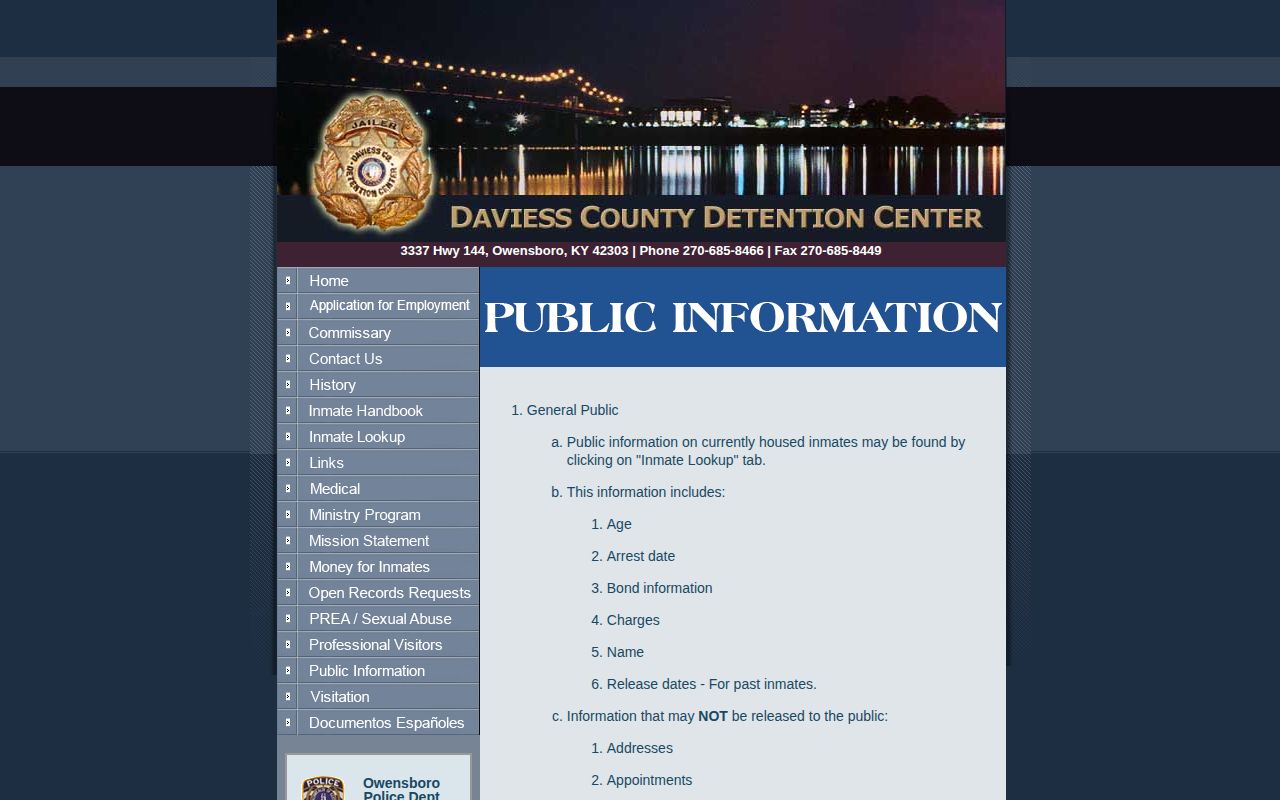
This policy is the county basis for using a historical booking after a person leaves the live roster. The screenshot should be read with the current official text because the vendor interface can change.
Daviess State Offender Search
KOOL is Kentucky's core state-offender lookup. Search with minimal name data, then confirm the DOC or PID number, conviction county, offense, and dates. It can distinguish a prison or jail location from District 13 community supervision. Its projected-date filters do not confirm a completed release.
| Search field | Use |
|---|---|
| Name and aliases | Find spelling variants |
| DOC or PID number | Confirm a unique state record |
| Supervision status | Separate custody, community supervision, and discharge |
| Location and county | Identify prison, jail, or supervision office |
| Offense and conviction | Resolve namesakes |
| Projected Release Date From/To | Filter an administrative estimate, not an actual event |
The DOC Daily Releases archive adds dated PDFs with DOC number, release type, and location. A DCDC location covers a DOC-administered event at the local jail, not all county releases.
Daviess Release Search Channels
VINELink covers participating local and state custody and can show a released result or send alerts. Kentucky warns that one state offender may have both a local-jail and DOC VINE record, so both may need registration. A VINE event is a lead, not a certified release sheet. The dedicated VINELink inmate search explains the confirmation and PIN process.
CourtNet provides a case index. The Daviess Circuit Court Clerk provides file-stamped judgments, bond orders, dismissals, probation orders, and expungement orders. For a federal sentence, the BOP locator can show a historical release date. A federal pretrial detainee may require the federal docket or USMS channel. ICE's locator is a conditional path after a detainer or transfer.
Probation is imposed by a court. Parole is conditional release ordered through the Parole Board. Kentucky DOC District 13 in Owensboro supervises qualifying Daviess County cases. A KOOL location there means supervision in the community, not incarceration at the office.
Daviess Custody Status Sources
Choose the record by the question being asked. The current roster answers who DCDC reports as held now. A past record answers when a local episode ended. State and federal systems cover their own populations.
| Source | Best use | Key limit |
|---|---|---|
| DCDC current lookup | Current local custody | Absence does not prove release |
| DCDC past record | Executed local release date | No fixed online retention promise |
| KOOL | State custody, sentence, supervision, discharge | Not every county-only booking |
| DOC Daily Releases | Dated state release event | Not a total DCDC doors-out list |
| VINELink | Participating custody alerts | Can lag or conflict |
| BOP locator | Sentenced federal history | May omit USMS pretrial custody |
Daviess County Release Facilities
Daviess release paths include custody agencies, a supervision office, court detention records, and reentry systems. Each linked page explains what the entity does and what record confirms movement or release.
- Daviess County Detention Center, the primary local jail for county, state, and federal populations.
- Kentucky Department of Corrections custody network, the statewide sentence and discharge path.
- Kentucky DOC Probation and Parole District 13 - Owensboro, a community-supervision office.
- Daviess County court detention path, the filed-order source.
- Federal Bureau of Prisons system, for sentenced federal records.
- ICE detainee locator and detention system, used when immigration facts apply.
- Owensboro Day Treatment program, a local program path rather than a jail roster.
- Parole
- Conditional release before sentence completion.
- Probation
- A court-imposed community sentence.
- Time served
- Credited confinement satisfying the relevant term.
- Detainer
- Another authority's request that may continue custody.
- Discharge
- The end of the stated custody or supervision authority.
Public Record Search
Sponsored Results