
Daviess County VINELink Coverage
Kentucky VINELink is the public face of VINE, the Victim Information and Notification Everyday system. Kentucky materials describe coverage for participating local jails, adult correctional institutions, and certain juvenile and mental-health facilities. For a person tied to Daviess County Detention Center, VINELink can report the current custody state or show that the person is no longer held. The Kentucky Attorney General explains that a released result may include the release date. An in-custody result may identify the jail or institution and provide its address and telephone number.
VINELink and the Kentucky Online Offender Lookup, or KOOL, serve different needs. VINELink spans local custody and emphasizes event notices. KOOL carries richer state sentence, location, parole, and supervision data. Neither service is a federal locator. A federal case calls for the Bureau of Prisons locator or the federal case record. A Daviess County release to a detainer or another agency is also continued custody, even if the local jail record closes.
Run a Daviess VINELink Search
Start with the smallest reliable set of details. A partial name can help when spelling varies, while a jail, offender, PID, or DOC identifier gives a stronger match. Names alone are not unique. Compare the reporting agency and all identifiers before opening a record. The same person can have more than one Kentucky VINE entry when local jail custody and state corrections authority overlap.
- Open the Kentucky VINELink page or call the statewide service at 1-800-511-1670.
- Select Kentucky, then choose Find an Offender.
- Enter a partial name or a known jail, offender, PID, or DOC identifier.
- Compare the agency, identity details, and identifier for each possible match.
- Open the correct record and read whether it reports current custody or no longer in custody.
- If both a local-jail and DOC record appear, check each record because their events differ.
A blank search is not proof of release. It may reflect a spelling mismatch, a transfer, a timing gap, a nonparticipating agency, or a record that changed after the event. Retry an alternate spelling or identifier. Then contact the facility that last held the person. The broader named-person workflow on the Daviess County released-inmate search adds jail, court, DOC, and federal channels when VINELink alone is unclear.
Daviess VINELink Release Results
The result must be read as a custody snapshot, not a full legal history. A status of released or no longer in custody may carry an event date. It does not by itself explain the court order, bond, sentence credit, detainer, or destination. If the person remains held, the record may name the current agency. State alerts can use more detailed event terms, including parole, court-ordered release, shock probation, home incarceration, return to custody, and an approaching scheduled release.
| VINELink item | What it supports |
|---|---|
| Name and identifier | Distinguishes the selected record from a namesake. |
| Custody status | Shows the participating agency's present reported state. |
| Agency or facility | Identifies the jail or institution tied to the record. |
| Release date | May show when a no-longer-in-custody event was reported. |
| Event type | May distinguish release, transfer, escape, death, or another covered change. |
| Advanced Release | Means a DOC release is approaching, not that release has occurred. |
County and state terms should not be merged. A DCDC past-inmate release date proves the local custody event. A KOOL released or discharged status and a dated DOC Daily Releases entry document a state event. A VINELink record can corroborate either, but it does not replace the source record when the exact time or legal basis matters.
Kentucky VINELink Search Screen
The official Kentucky VINE interface presents the person search and notification path used for Daviess County custody checks.
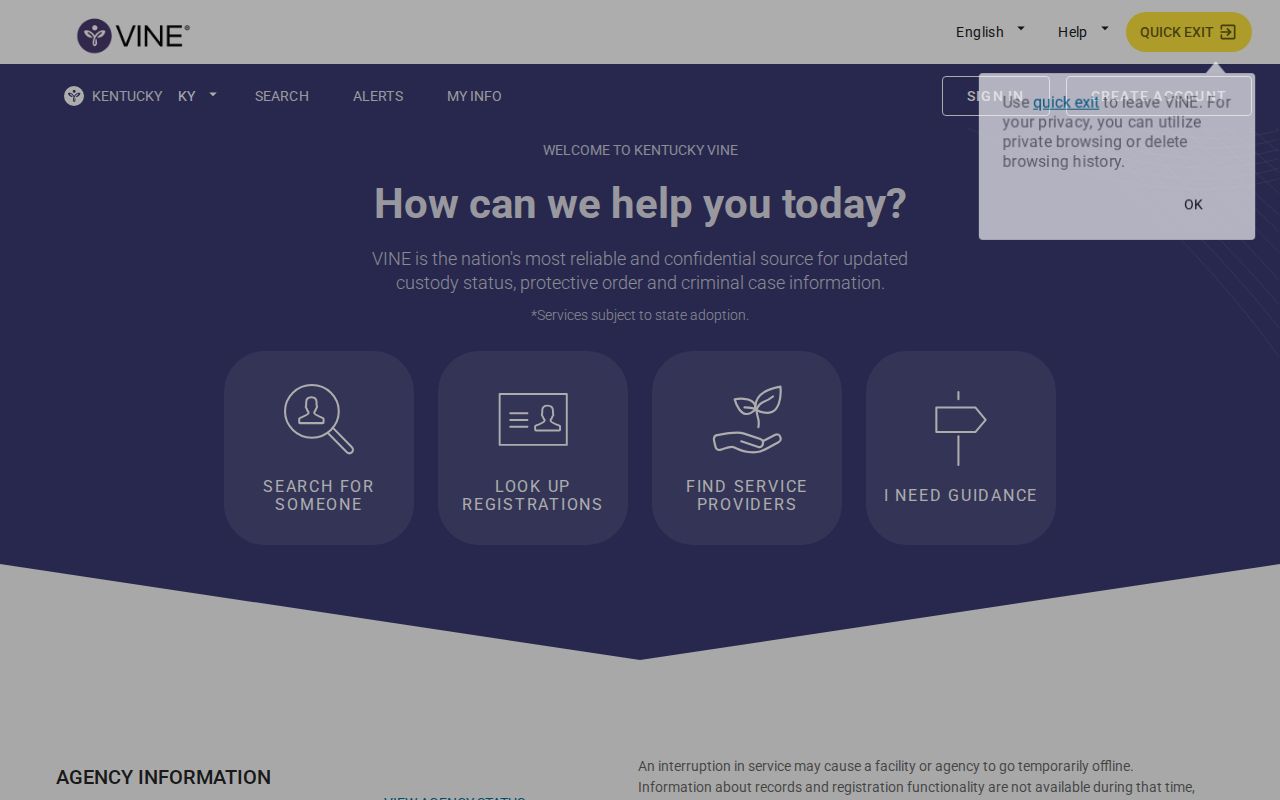
The screen is a starting point. Open the matching record, confirm the agency, and save the event details if another official source later conflicts with the alert.
Set Daviess Release Alerts
Registration begins inside the correct person record. Choose Notify Me of Status Changes and follow the methods currently offered. Telephone, email, and text may be available. More than one destination can be registered. Avoid a telephone line that ends at a switchboard, since the call must reach the person who can acknowledge it.
- Confirm the person, identifier, and participating agency.
- Select the notification option in that record.
- Choose each offered telephone, email, or text method that fits the need.
- Enter the destination and complete the displayed verification.
- For a voice registration, create a private four-digit PIN.
- When a call arrives, enter the PIN as prompted to hear and acknowledge the event.
Kentucky's official brochure describes entering the PIN followed by the pound key. Jail-release calls may repeat at short intervals for up to a day until acknowledged. Calls can arrive at any hour and may leave voicemail. Keep the PIN private. A notice should prompt a check of the facility record, especially when the event concerns a transfer or an approaching release rather than a completed release.
Notification timing depends on the event. Kentucky materials describe advance notice for some state-institution releases when practicable, plus quick notice for a court-ordered discharge, a change in time credit, or an escape. Those labels do not all mean the same thing. Read the event text before telling anyone that physical custody ended.
Two Daviess VINE Records
Kentucky DOC gives a distinctive warning: one state offender may have both a local-jail VINE record and a DOC VINE record. This can happen when a person is held at Daviess County Detention Center under state authority. Register on both matching records. The jail entry tracks the local custody episode, while the DOC entry may carry state sentence or release events. Watching just one can miss a transfer or produce an incomplete account.
Agency identity resolves the apparent conflict. A DCDC disappearance could reflect a move within the state system. A DOC location at District 13 in Owensboro means community supervision, not incarceration at an office. Compare KOOL's DOC or PID number and location with the VINELink entry, then use the dated release record for final confirmation.
Daviess Custody and Court Tracking
VINEcourts is no longer provided through Kentucky DOC Victim Services. Custody notifications and court-case tracking now require separate systems. Use VINELink for participating custody events. Use the Kentucky Court of Justice guest case search and the Daviess Circuit Court Clerk for a filed order, judgment, bond action, dismissal, or probation order. A court date or release order shows legal authority, while the jail record shows when DCDC carried it out.
This split matters after release. A court event may appear before jail processing is complete. The reverse can also occur when the brief event text lacks the legal detail found in the filed order. Keep the VINELink event date and agency, then match them to the correct booking and case.
Missing Daviess VINELink Records
When a known custody episode does not appear, work outward from the last confirmed agency. Search DCDC's official JailTracker with less name data and review past bookings. For a state case, retry KOOL with an alias, DOC number, or PID number. A person held locally under Kentucky DOC authority may be easier to identify in KOOL even when the VINELink name search fails. Do not assume that silence means the person was released.
Next, check the suspected date in the Kentucky DOC Daily Releases archive when a state sentence applies. Those dated PDFs list DOC number, name, release type, releasing location, and felony class. A Daviess County Detention Center location means the release occurred under DOC authority at the county jail. It is not a complete list of DCDC releases. For a county-only booking, ask DCDC for the booking and release sheet instead.
If the problem concerns a notification registration, verify the destination and confirmation step. A voice alert may continue until the PIN is entered. Email or text registration may require a link or code. The available interface can change, so follow its current prompts and keep a copy of the confirmation. Facility staff can confirm custody facts, but they may not be able to repair a vendor account. Preserve the person's identifier, agency, alert time, and wording when reporting an apparent error.
Verify Daviess VINELink Alerts
Kentucky has strong event trails, but each has limits. DOC publishes date-by-date Daily Releases PDFs. KOOL includes state status, sentence, location, and parole history. VINELink provides fast event notices. Research also found an archive date-label mismatch in a DOC release file and a documented February 2026 vendor incident that produced false VINE release alerts. That record makes two-source verification essential.
For an ordinary DCDC release, begin with the official past-inmate record and request the booking and release sheet if needed. For a state-sentence release, match the DOC number across KOOL and Daily Releases. Check the listed release type and location together. If the event is federal, use the BOP locator or federal docket instead. When an alert conflicts with a live roster, call the holding agency and preserve the alert details so the event can be corrected.
- Projected release
- An administrative estimate that may change.
- Proposed release
- A date associated with a parole action, not a completed event.
- Discharge
- The end of the relevant custody or supervision authority shown by the record.
- Detainer
- A request by another authority that can lead to continued custody after the local case ends.
Mandatory reentry supervision adds another layer. Kentucky law can require a qualifying release near projected completion even without a Parole Board grant. Read the DOC event type instead of calling every supervised release parole.
Public Record Search
Sponsored Results